
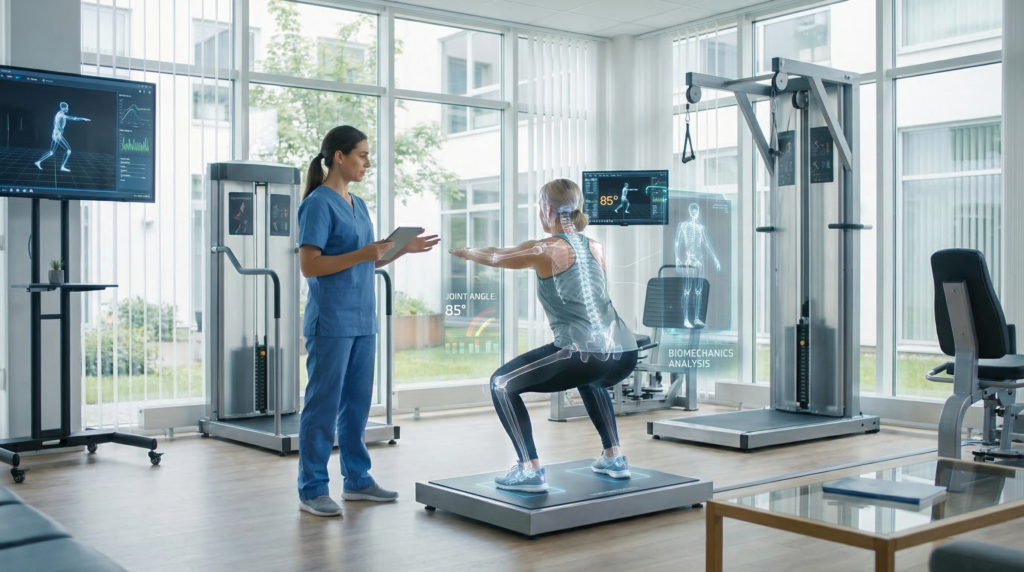
Artificial intelligence is transforming how practitioners assess, diagnose, and treat musculoskeletal conditions. At Thrive Physiotherapy, we integrate cutting-edge machine learning technologies to deliver superior patient outcomes and accelerate recovery timelines.
What is Artificial Intelligence in Rehabilitation?
AI refers to the application of machine learning algorithms, computer vision, and predictive analytics to enhance clinical practice. These technologies enable more precise movement analysis, personalised treatment planning, and data-driven decision-making throughout the rehabilitation process.
The integration of machine learning extends beyond simple automation. Modern intelligent systems analyse complex patient datasets to generate individualised treatment protocols that adapt in real-time to patient progress.
7 Ways Technology Transforms Recovery
1. Computer Vision Motion Analysis
Computer vision represents one of the most significant artificial intelligence innovations in rehabilitation. Deep learning algorithms capture and analyse patient movements through standard video feeds, identifying subtle deviations in gait patterns and joint mechanics.
Research demonstrates that intelligent systems can detect movement abnormalities approximately 30% earlier than conventional assessment methods. This early detection capability facilitates timely intervention and prevents acute conditions from progressing to chronic pathology.
2. Personalised Treatment Planning
Machine learning systems analyse comprehensive patient datasets to generate bespoke rehabilitation programmes. These platforms consider medical history, injury mechanisms, demographic factors, and treatment responses.
Treatment planning with intelligent algorithms reduces recovery timelines by an average of 25% compared to standardised protocols.
3. Predictive Analytics
Predictive modelling represents a transformative application of data science in musculoskeletal care. By analysing patterns from extensive clinical datasets, these systems forecast recovery trajectories with considerable accuracy.
4. Enhanced Telehealth Services
The widespread adoption of telehealth has accelerated smart technology integration into remote care delivery. Virtual rehabilitation platforms employ advanced systems to guide patients through exercises with real-time form correction.
5. Wearable Technology Integration
Smart wearable devices provide continuous monitoring of patient progress outside clinical settings. These technologies track activity levels, physiological parameters, and movement patterns throughout daily life.
6. Automated Progress Tracking
Machine learning algorithms automatically track patient progress, adjusting treatment protocols based on real-time data. This ensures optimal intensity and prevents both undertraining and overtraining.
7. Evidence-Based Decision Support
Intelligent systems provide practitioners with evidence-based recommendations drawn from millions of similar cases, supporting clinical reasoning while maintaining essential human expertise.
Benefits of Smart Technology
The advantages of artificial intelligence in rehabilitation include:
- Millimetre-precision movement assessment
- Objective measurement of range of motion
- Identification of compensatory movement patterns
- Real-time feedback during exercise performance
- Longitudinal tracking of functional improvements
- Personalised protocol generation
- Predictive recovery forecasting
How Smart Systems Create Personalised Protocols
The personalisation process involves:
- Data Collection: Comprehensive patient assessment data
- Pattern Recognition: Machine learning analysis of similar cases
- Protocol Generation: Individualised treatment recommendations
- Adaptive Refinement: Real-time adjustments based on progress
The Future of Intelligent Rehabilitation
Emerging technologies promise increasingly sophisticated applications:
- Augmented reality rehabilitation: Immersive exercise guidance systems
- Natural language processing: 24/7 patient communication support
- Genomic integration: Treatment personalisation based on genetic analysis
- Robotic assistance: Smart movement retraining devices
Technology-Enhanced Care at Thrive
Thrive Physiotherapy remains committed to implementing evidence-based intelligent innovations. Our practitioners utilise advanced systems as sophisticated decision-support tools, enhancing clinical reasoning while maintaining essential human connection.
Book Your Technology-Enhanced Consultation
Discover how our AI-enabled approach accelerates recovery.
For enquiries regarding artificial intelligence in rehabilitation or to discuss how technology-enhanced care might benefit your condition, contact our clinical team for a complimentary assessment.
Related Articles
- Home Physiotherapy: Technology-Enabled Care
- Manual Therapy Techniques
- Sports Injury Rehabilitation
- Chronic Pain Management